My photo
This is my photographer’s blog, for your consideration. I post some of my favorite shots here, usually along with some comments about how the photo was taken or post-processed. (Occasionally I have the vain thought that someone might like to read about that.)

If you like what you see here, feel free to check out my Flickr site and YouTube channel.

Monday, October 15, 2012

Green Sky in the Morning

IMG_1390_rc_sml

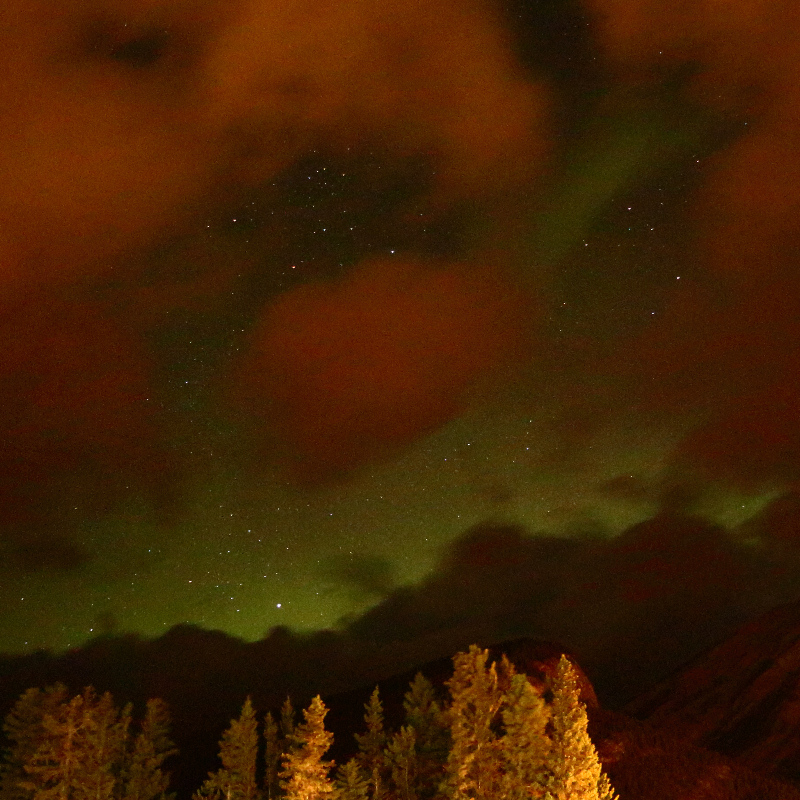
It was about 4:00 in the morning on Saturday when my cell phone sounded the alert for a possible geomagnetic storm brewing (courtesy of spaceweather.com).  Kathy and I were vacationing in Banff, Canada, and I could see some reddish clouds in the sky, nicely reflecting the town's lights.  Stars were visible, yet no auroras.  But wait -- the clouds in the northeast were silhouetted, indicating that something was lighting up the sky behind them.  Perhaps the coming dawn?  No, it was much too early for that in Banff; sunrise would not be until 8:03am.  Eventually the effect brightened and it became obvious that this was indeed an aurora -- the Northern Lights.

It did not look much like the spectacular images in the astronomy web sites -- usually taken from Alaska or other high latitude regions, without clouds in the way.  But it was the first time Kathy and I had seen them at all, so the view was amazing enough for us!

One thing you may not know is that the picture-book photographs of auroras are all time exposures -- mine was 6 seconds at f/4 with ISO 6400.  So, like for most nighttime sky views, photography enhances our ability to see and appreciate the Northern Lights.

Thursday, October 4, 2012

Family, Fun, and Physics

IMG_0376_rc_sml

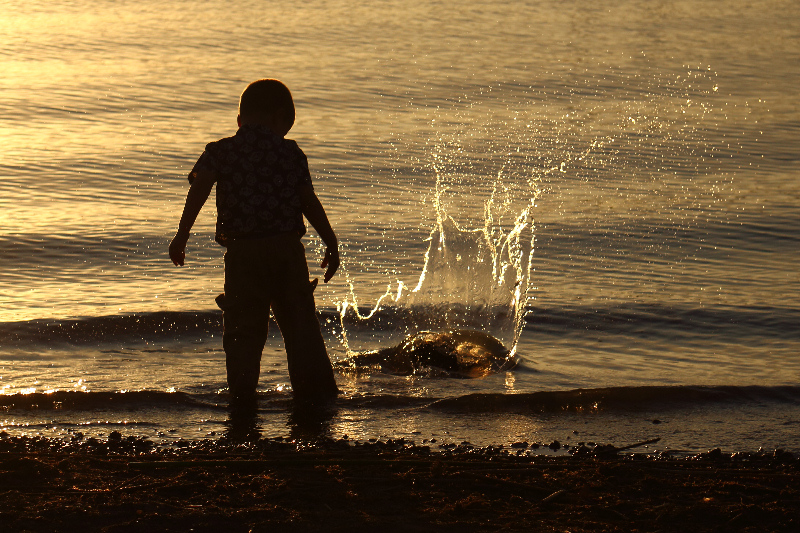
This is my grandson John, throwing a rock into the water of Fern Ridge Lake near Eugene. We're talking a big rock, as you can see here:

IMG_0356b_0381_rccp_sml

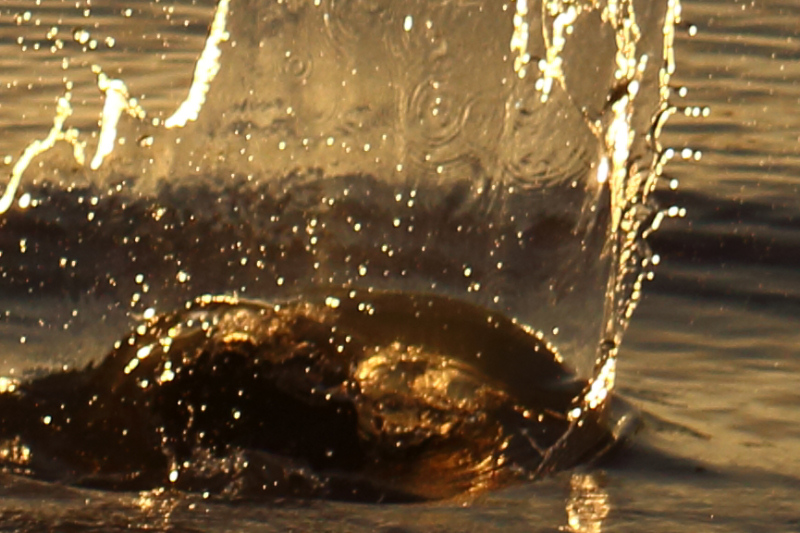
Big rocks make big splashes, which fascinated John -- but not nearly as much as they fascinated me when I enlarged a portion of the 1/1500 sec shot.

IMG_0376_rccp3_sml

So much is visible in that frozen instant of time (0.0007 sec.)!  The rock itself is continuing to push down into the water after expelling a window-thin sheet of water upward.  Through the "window glass," you can see a secondary shock wave getting sent backward.  But my favorite feature of the brief apparition is a set of concentric rings on the sheet itself, caused by water droplets striking it like pebbles dropped in a pond. (Click on the image to see this better.)

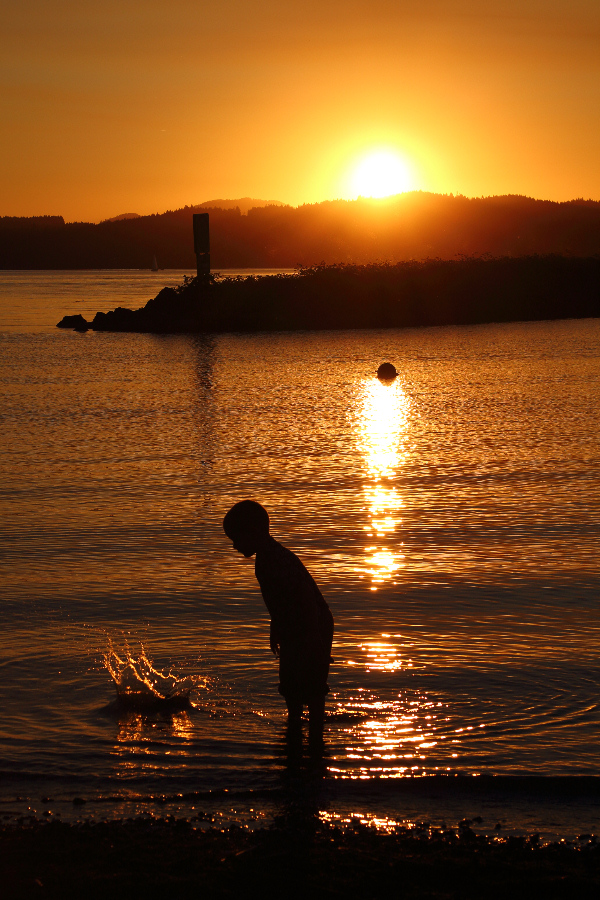
Grandson John did not need any photographic enlargements to be entertained however.  He kept it up all the way to sunset, splash after splash:

IMG_0400_rc_sml

It was a glorious afternoon -- we enjoyed family, a gorgeous sunset, and Physics.

Wednesday, July 11, 2012

Herbert the Snail

IMG_7480_sml

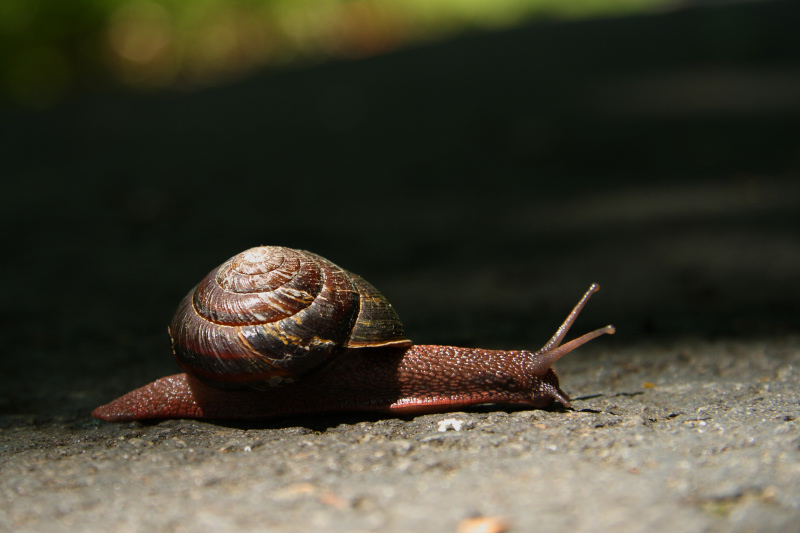
This is "Herbert the Snail."  At least, that's what I named him.  Some of you may remember listening to The Music Machine tape (yes, I mean cassette tape) with your kids in the car -- or, as a kid in the car.  One of the memorable songs was Patience (Herbert the Snail).  Click here to listen to the line from the song that inspired this photo.  It starts with Herbert singing in slow snail-speak, "Have patience, have patience, don't be in such a hurry...."

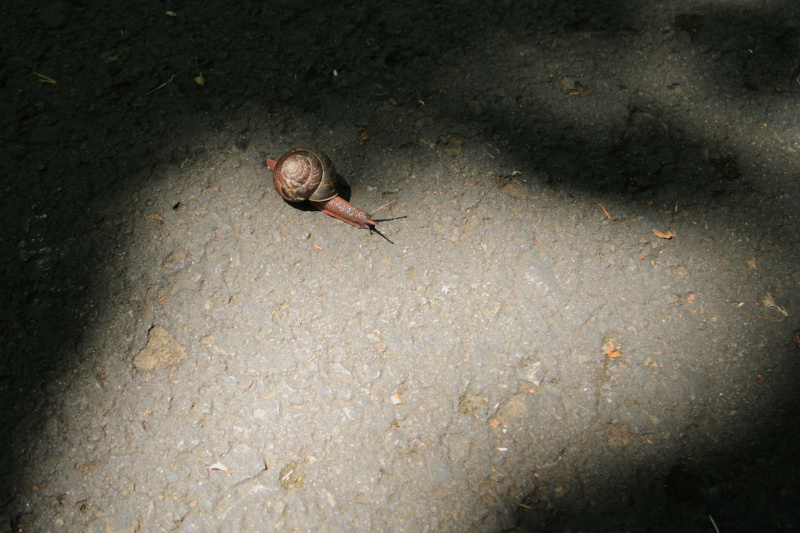
Indeed, snails don't hurry.  Kathy and I came across Herbert while we were walking around the lake in Vernonia last Saturday.  He had just emerged from a shadow, and was ponderously making his way across a patch of sunlight on the lakeside path:

IMG_7475_sml

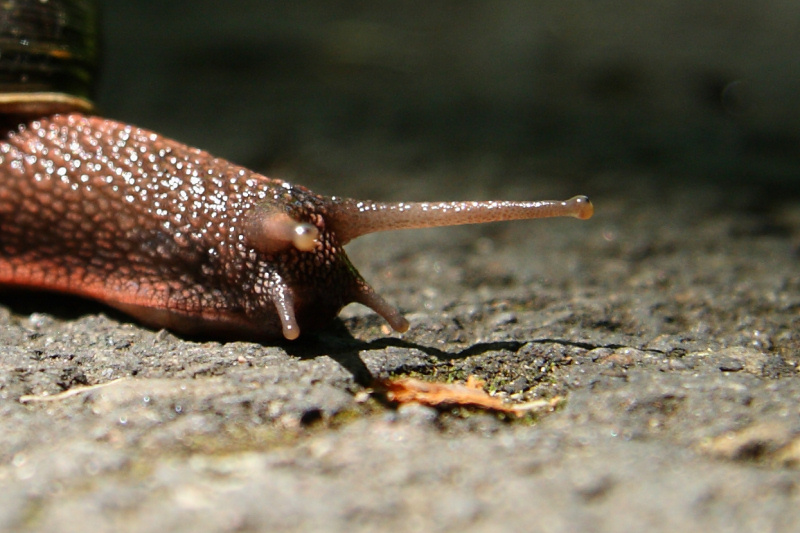
I wanted to get to know Herbert better, so I took some photos at his eye level.  He stretched one of his eye spots to the fullest to greet me -- or or maybe he was just looking for obstacles.  (It's hard to read a snail's emotions.)

IMG_7487_sml

In any case, Herbert provided a vivid example of being unhurried -- a trait it would be good for us all to consider in the midst of our fast-paced lives.  :-)

Wednesday, June 13, 2012

Venus Transit Bookends

IMG_7021_rc_sml

There are hundreds -- maybe thousands -- of Venus Transit photos blanketing the web right now.  Many of them look almost exactly the same, showing the Sun with the black disk of Venus amid a pattern of sunspots that will be long-remembered.  (See the previous blog posting for my contribution to this same-ness.)  But when clouds and foreground are added, suddenly everyone's photo is different.  The photo above is one of my contributions to this variety -- as the Sun dipped lower in the sky, there were some clouds to add interesting pixels to the image.

From San Francisco, the Transit started at 3:06 pm and continued until the Sun dipped below the horizon at 8:44 pm with the transit still in progress.  The next two photos represent the bookends of my experience -- the Venusian ingress on the front end and a picturesque sunset on the back end.

IMG_6748_rcrsrssh

IMG_7035_rc_sml

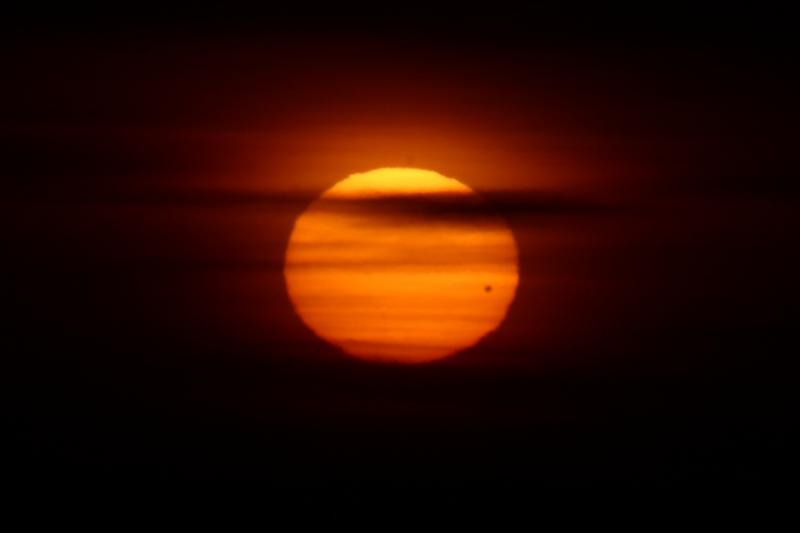
You may have noticed that in the last photo above, the image of Venus has been elongated vertically.  Of course, this is due to the distortion of the Sun's setting image as its light rays slog through layer upon layer of atmosphere at the tail end of its 93 million mile journey to my camera lens.

Throughout the transit, there were also various non-Venus scenes that presented themselves near my San Francisco Cliff House location.  To see all 9 images, see my associated Flickr set (slideshow).

All in all, June 5, 2012 was a very memorable day!  :-)

Thursday, June 7, 2012

Dark Venus

IMG_6850_rc_sml2

Tuesday I was in San Francisco gazing at the Sun through solar-filtered binoculars -- then it happened. The planet Venus crossed in front of our star.

For almost seven hours, the brightest planet in the sky went dark -- a jet-black disk against the bright Sun. This was the last time it will do so until December of 2117. Persons born today must live to 105 if they plan to view the next Venus Transit.

Altogether, I shot about 450 pictures of the event; my first -- and last -- attempt at Venus Transit photography. In the coming days and/or weeks, I'll share some more of the photos. But for now, the image that is burned in my mind is the one above: Dark Venus gliding in front of the Bright Star.

Monday, May 21, 2012

Crescent Sun

IMG_6438_rc_sml

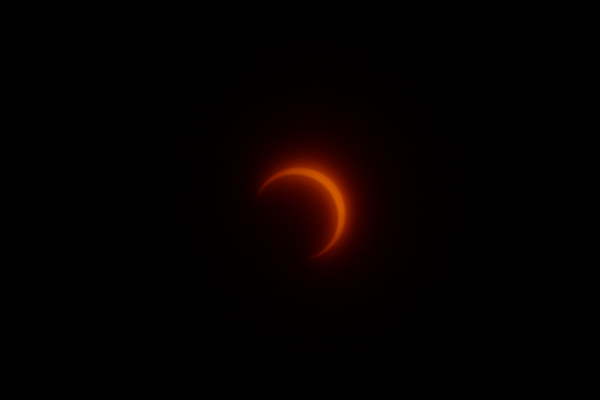
On Sunday in Eugene, we were treated to a partial solar eclipse where 85% of the Sun's disk was covered by the Moon gliding in front of it. Of course this is Oregon, and our clouds decided they wanted a piece of the action too.  In many parts of the state (e.g. Portland), the event was invisible except for a few glimpses of the Sun through thick clouds.  Fortunately, the Eugene clouds were thin enough to reveal the Crescent Sun throughout much of the eclipse.

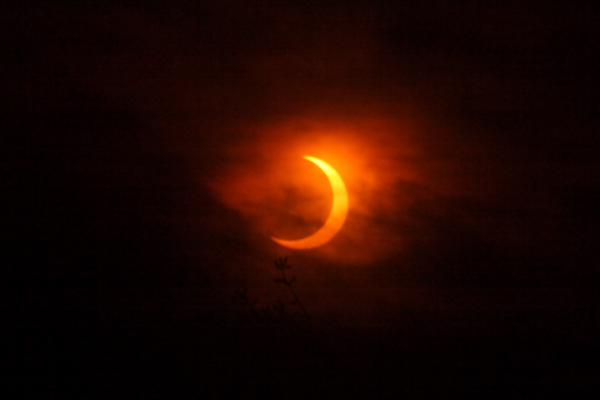
At 6:23pm, the coverage reached its peak of 85.4%.  Here is what it looked like, exposed for the crescent through some non-picturesque clouds:

IMG_6381_rc_sml

Unless you were hiding from news outlets in the days leading up to Sunday's eclipse, you know this was an annular type, which means the Moon is too far away to completely cover the Sun -- but still tries its best anyway. The result is a "ring of fire" during the few minutes that the Moon's disk appears completely inside the Sun's disk. Unfortunately for my photographic ambitions, I was not in the path of annularity this time -- but as you can see, it was fairly close.

On August 21, 2017, we will get a total solar eclipse, revealing the beautifully delicate solar corona.  The west-to-east path of totality will include McMinnville in the north to Alsea in the south.  I viewed the previous total eclipse that graced the contiguous United States in 1979, and I can assure you it will be worth your effort to see the next one in 2017 .  :-)

Friday, April 6, 2012

Venus Says Goodbye to Sisters

IMG_5855_rcsp_sml

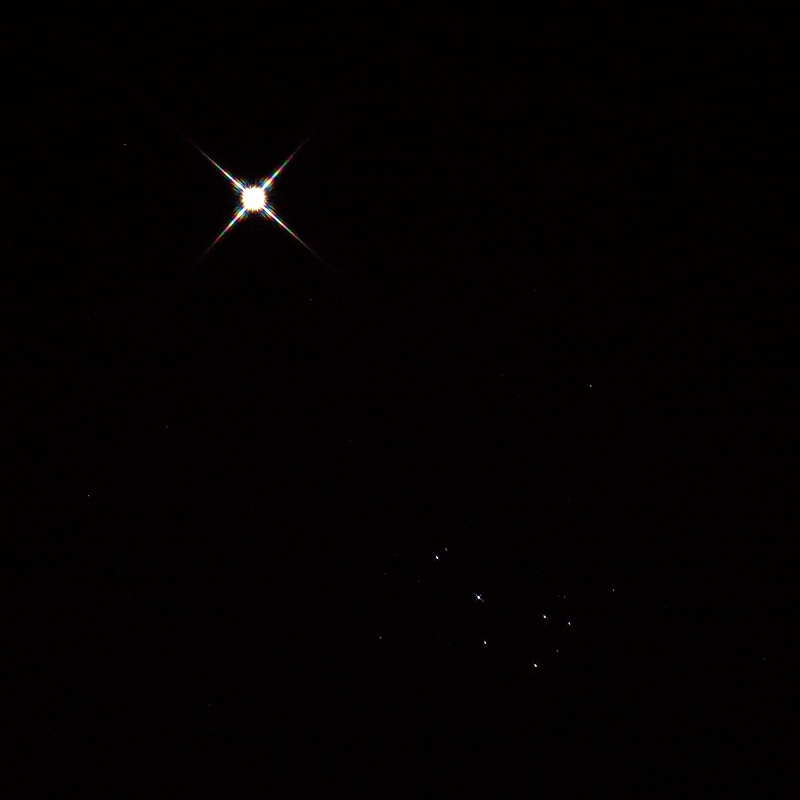
The Oregon clouds finally cleared and I was able to capture Venus and the Pleiades in the same shot. Of course, photographers who were graced with clear skies earlier this week obtained much better photos, since Venus glided right through the famous star group also called the "Seven Sisters."

Oh well; it was still a gorgeous view tonight, even as Lady Venus said goodbye to the Sisters. :-)