My photo
This is my photographer’s blog, for your consideration. I post some of my favorite shots here, usually along with some comments about how the photo was taken or post-processed. (Occasionally I have the vain thought that someone might like to read about that.)

If you like what you see here, feel free to check out my Flickr site and YouTube channel.

Monday, February 22, 2010

Astrophotography With a Camera and Telescope

IMG_8498_rc_sml

In a pair of postings awhile back (Jupiter and His Minions and Astrophotography With a Camera and Tripod, I said, One of these days, I'll mate my camera to a telescope, and then I'll be a "real" amateur astrophotographer.

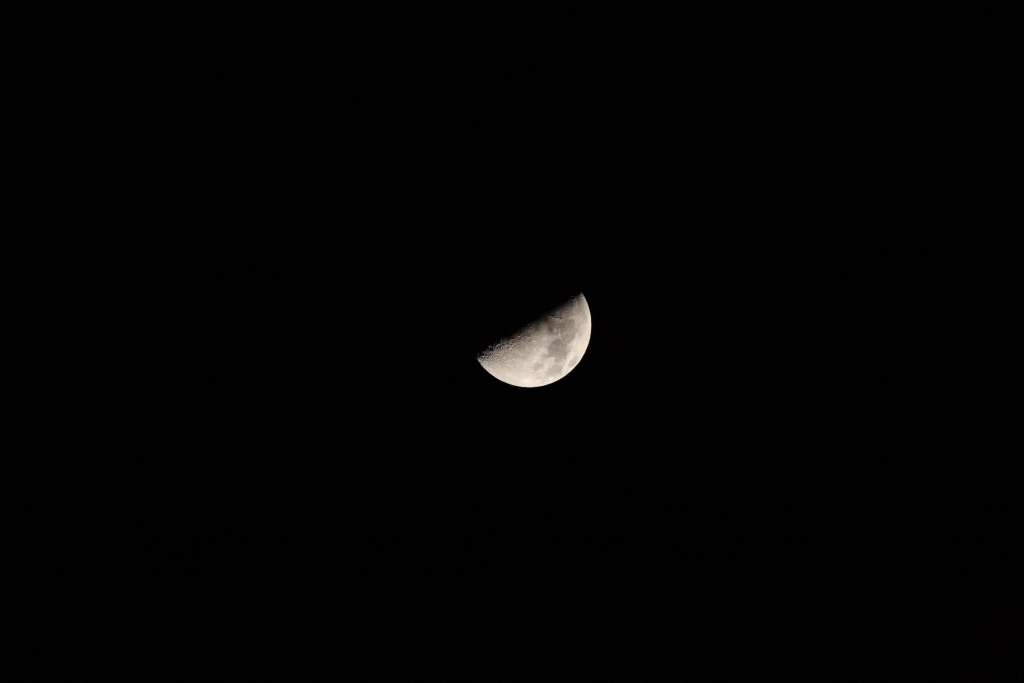
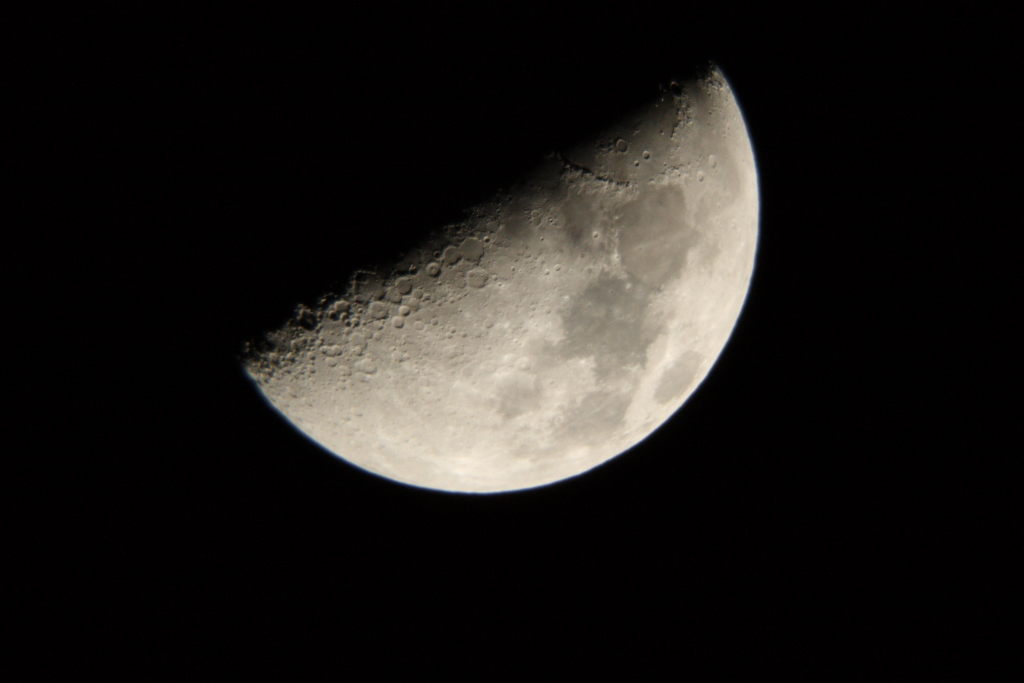
Well, I guess that day has finally arrived. The photo above is a full-frame view of the Moon, shot through my telescope.

In contrast, here is the equivalent full-frame shot taken at maximum zoom with my longest telephoto lens:

IMG_8509_rcsp_sml

But the difference is most noticeable when we zoom in on some detail:

IMG_8509_zoom3

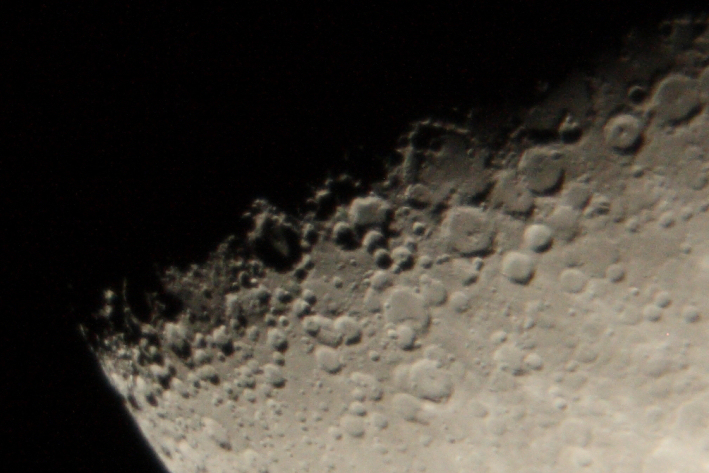
The telephoto "detail" is not very usable, as you can see. In contrast, the telescopic shot's detail looks like this:

IMG_8496_rc_zoom3_rs

Of course, a "true" amateur astrophotographer will get results that are much sharper. And indeed, my later shots will improve, once I get an official camera mount and can then do image stacking. (This "Proof of Concept" was taken by pointing my camera into the telescope's viewfinder, hand-held.)

In any case, I'm happy with the results of this casual Proof of Concept! I see much potential for future astrophotos. :-)

Tuesday, November 17, 2009

More Liquid HDR

IMG_5118_hdr_hsa_5_4_10_cfcpsp_sml

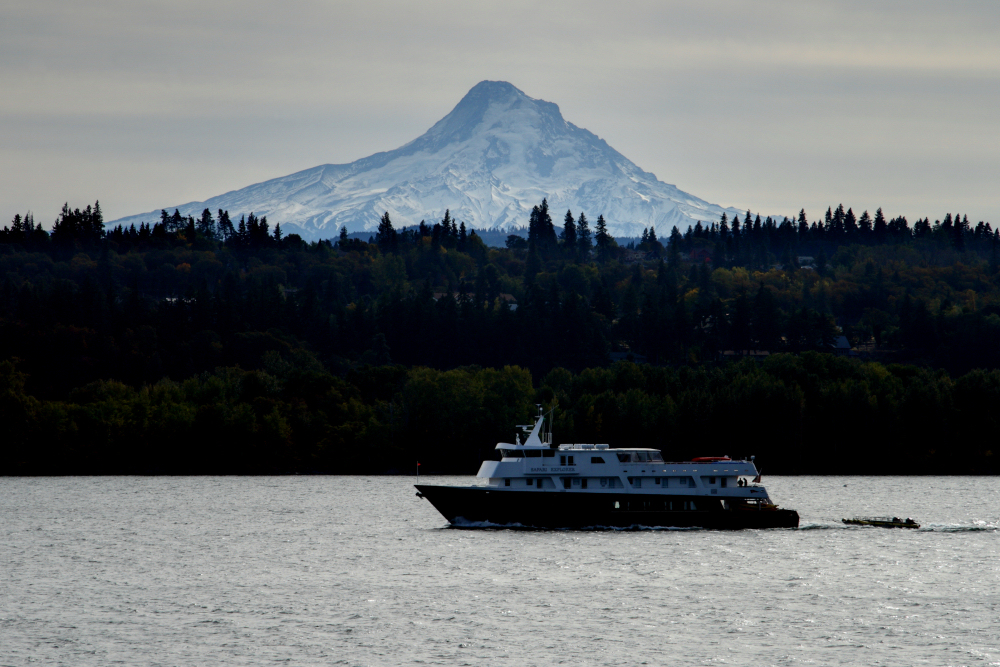
Waves on water. Moving boat against a static background. Back-lit hillside with almost-backlit mountain. Bright high cloud layer. Impossible shot. Until now. (Click on the image for closer examination.)

Using my recently-discovered RAW-format HDR technique, I "developed" three exposure levels from one photograph containing the dynamic range of 36 bits per pixel instead of JPEG's 24 bits:

IMG_5118_u_sml

IMG_5118_o_sml

IMG_5118_n_sml

Photomatix helped me blend the three exposure levels into a shot that balances the highlights and shadows similar to the way my eyes did as I gazed at Mount Hood across the river from the Washington side of the Columbia Gorge. Here it is again, for comparison with the three component shots:

IMG_5118_hdr_hsa_5_4_10_cfcpsp_sml

I know, I sound like a broken record about HDR -- but it's one of those tools I now consider to be essential. Also, shooting 36-bit RAW, every shot is automatically bracketed for post-production exposure optimization and potential HDR processing.

Who says an old dog can't learn new tricks? :-)

Tuesday, November 10, 2009

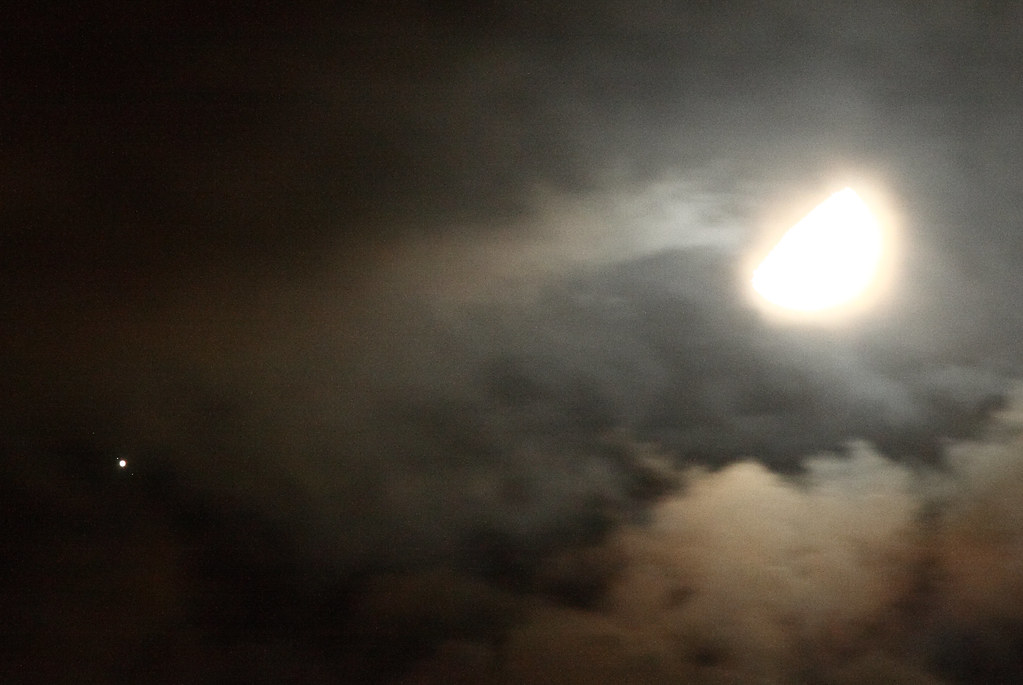
Moon Plus Moons

IMG_5745_hdr_bi_-10_0_40_cfsp_sml

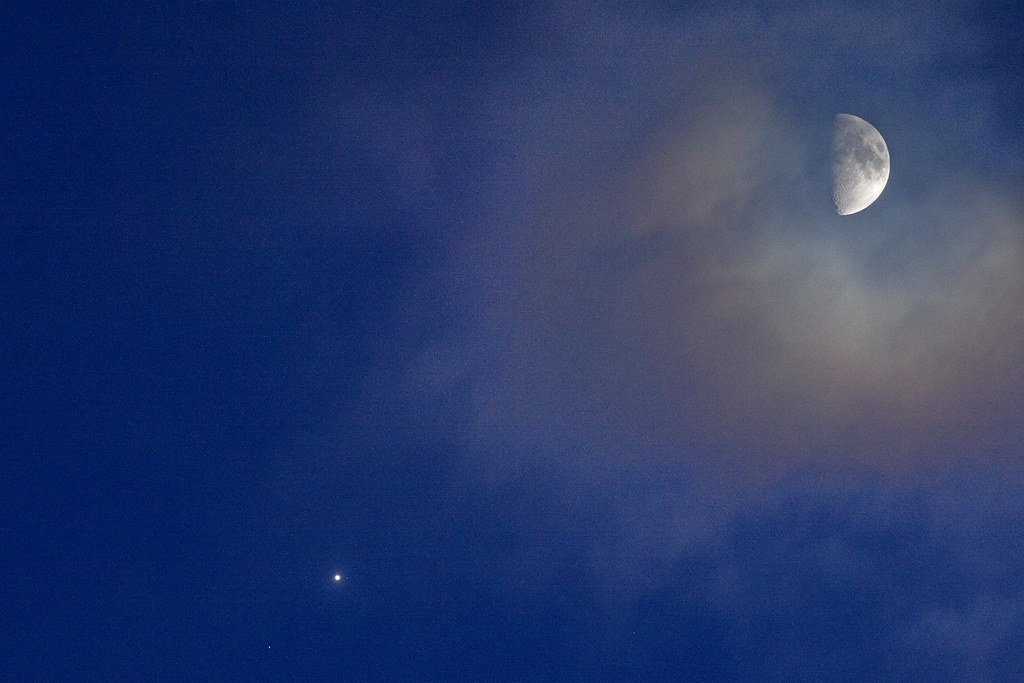
This is a very difficult shot to get, but you can't tell that from just looking at this downsized version. You can see the Moon, of course -- and Jupiter nearby. Although planetary conjunctions are not exactly uncommon, it is fairly rare to catch the Moon behind a dark translucent cloud in the same photo as a planet which is not behind a cloud. And, it's even more rare for that planet to be Jupiter. I have been trying for a long time to get our Moon in the same shot as the moons of Jupiter. The only way to capture that combination is for our Moon to get behind a cloud that is dark enough to allow a long-ish exposure for the moons of Jupiter. Last month, it almost worked.

I say "almost" because the moon chose to hide a little too soon -- the sky was not dark yet. So, while Jupiter's moons are somewhat visible, it's nothing to write home about:

IMG_5745_hdr_bi_-10_0_40_cfsp_zoom1

Later that night, I obtained a much better dark-sky view of Jupiter's moons through an opening in the clouds:

IMG_5756a_spcp_zoom1

Unfortunately, the Moon was not bashful enough to find a sufficiently dark cloud for the shot.

IMG_5756a_spcp_sml

If you click on the image and view the shot full-screen, you can see the Jovian moons nicely in the same picture as our Moon. But someday I hope to capture the Moon as clearly as in the first shot, while the Jovian system is visible without zooming in.

But now it's winter in Oregon. Even if there is a favorable planetary conjunction of some kind, it's highly probable that they will be hiding behind thick rainclouds. Oh well. :-)

Monday, November 9, 2009

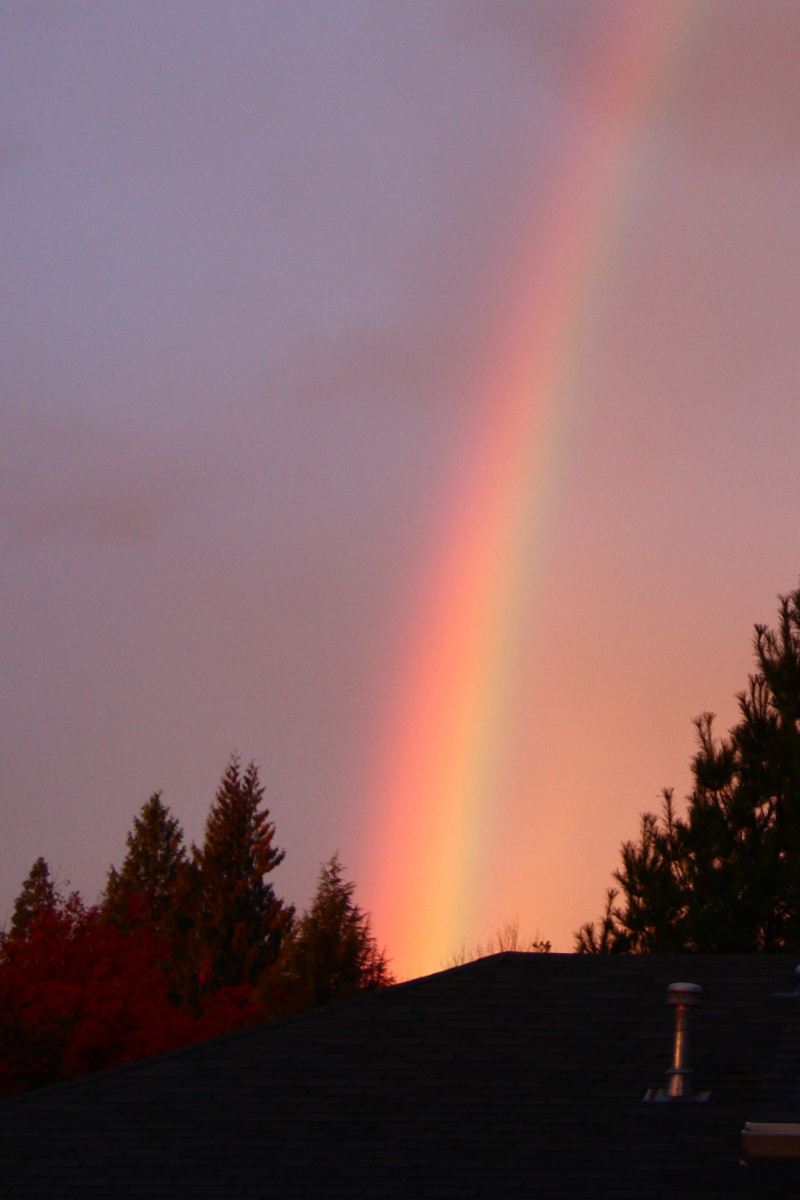
Pre-Sunrise Rainbow

IMG_6170_cp2_rc_sml

Here is something you don't see every day: A pre-sunrise rainbow. The landscape was still fairly dark, bathed in the dim golden light of the not-yet-visible Sun. But the moist atmosphere above had full sunlight. Rain droplets -- which later fell on our Oregonian heads -- acted as little prisms to create a beautiful column of color.

Wednesday, September 23, 2009

Galileo's Epiphany

jupiter_moon_sequence

Galileo could not deny what he saw through his new telescope. These were not stars, as he had first thought when he discovered the moons of Jupiter on January 7, 1610. The little pinpoints of light, arrayed in a straight line near the large planet, moved. Stars don't do that. Even in the space of 30 minutes, one could observe changes in position relative to the planet and to each other, as I witnessed and photographed on Tuesday. (Please pardon the third shot's quality; I was shooting through a thick smoky haze.)

On January 10, 1610, Galileo observed that one of the objects disappeared behind Jupiter, then re-emerged later. He concluded that these objects must be moons orbiting Jupiter. It was a mini "solar system," in plain view of anyone who cared to observe. Eventually, Galileo even worked out their orbits and could predict when and where the Jovian moons would show up.

This was an earthshaking finding. According to http://en.wikipedia.org/wiki/Galileo: A planet with smaller planets orbiting it did not conform to the principles of Aristotelian Cosmology, which held that all heavenly bodies should circle the Earth, and many astronomers and philosophers initially refused to believe that Galileo could have discovered such a thing. His observations were confirmed by the observatory of Christopher Clavius and he received a hero's welcome when he visited Rome in 1611.

However, Galileo's "hero" status was short-lived: Galileo's championing of Copernicanism was controversial within his lifetime, when a large majority of philosophers and astronomers still subscribed (at least outwardly) to the geocentric view that the Earth is at the centre of the universe. After 1610, when he began supporting heliocentrism publicly, he met with bitter opposition from some philosophers and clerics, and two of the latter eventually denounced him to the Roman Inquisition early in 1615. Although he was cleared of any offence at that time, the Catholic Church nevertheless condemned heliocentrism as "false and contrary to Scripture" in February 1616, and Galileo was warned to abandon his support for it—which he promised to do. When he later defended his views in his most famous work, Dialogue Concerning the Two Chief World Systems, published in 1632, he was tried by the Inquisition, found "vehemently suspect of heresy," forced to recant, and spent the rest of his life under house arrest.

At issue was the belief that the Bible delares the earth to be the center of the solar system: Psalm 93:1, Psalm 96:10, and 1 Chronicles 16:30 include (depending on translation) text stating that "the world is firmly established, it cannot be moved." In the same tradition, Psalm 104:5 says, "the LORD set the earth on its foundations; it can never be moved." Further, Ecclesiastes 1:5 states that "And the sun rises and sets and returns to its place" etc.

Of course, in hindsight all Christians now understand that these passages were written from the perspective of an observer; they do not address the astronomical relationship between the sun and the earth.

A friend of mine who is a pastor in California put it well: Careful observation of the natural world can cause Christians to go back to the Bible and reexamine whether it really teaches what we have understood it to say in the past.

Monday, September 14, 2009

Liquid HDR

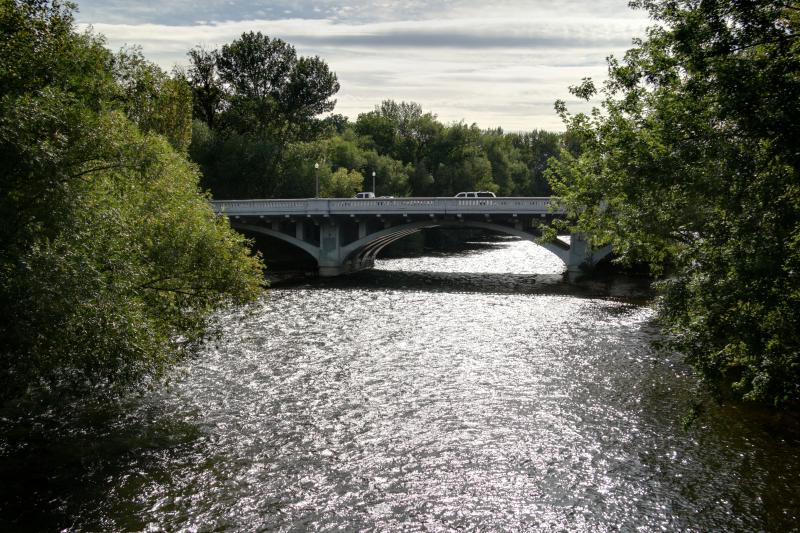
IMG_3537_hdr_river_0_3_0_cf_sml

On a recent trip to Idaho, we took a walk that crossed the Boise River on a footbridge. The photo above is what I saw from the bridge: sunlight glinting off the water's wavelets, a vehicle bridge with cars, and bright picturesque clouds in the sky. Surrounding the scene was late-summer green foliage, gently moving in the breeze.

Here was the camera's best effort to capture the scene in one photo:

IMG_3537_sml

The sun reflections were blown out, yet the back-lit bridge was underexposed. The overexposed sky lost cloud detail, but the trees were darkened by their underexposure.

Of course, the first photo is a High Dynamic Range picture, which rescued the scene. I have discussed HDR in numerous postings in this blog, but there has always been a problem: motion. In one posting ("Dynamic World Thwarts Dynamic Range Photography"), I lament the need for multiple photos to compile an HDR shot: "Until cameras start getting built with High Dynamic Range sensors to capture contrasty motion scenes in one shot, much of the dynamic world will remain out of reach of HDR photography."

Last week, much to my chagrin, I realized that the "until" time has already arrived for many motion HDR shots -- without the need to buy new equipment. The HDR photo above is an example of that "new" technology, enabling me to capture an High Dynamic Range image from a single instant in time -- a necessary feature for any photo with liquid water, breeze-blown tree leaves, etc.

As you may know, an ordinary JPEG digital photo is composed of data with 24 bits per pixel; 8 for each primary color. So, each color channel must be expressed with an intensity number of 0-127. That significantly limits the dynamic range. Wouldn't it be nice if cameras could capture more dynamic range in each shot?

Well, DSLRs do that very thing. In my case, the Canon 400D captures 36 bits per pixel; 12 for each primary color (0-2047). Then, when it constructs the 24-bit JPEG image to be stored on the memory card, it throws away the "extra" bits after applying color balance, contrast and sharpness parameters. But the original image's data -- all 36 bits -- is still available in the RAW format file, adding one or two stops of dynamic range. Duh. (Why didn't I think of that before?)

That lets me construct a triad of three exposures by "developing" the RAW data into JPEGs that are underexposed, normal, and overexposed. Then HDR software like Photomatix takes it from there.

With this realization, I will be able decide to use HDR after the fact. And, I'm no longer troubled by motion in the scene.

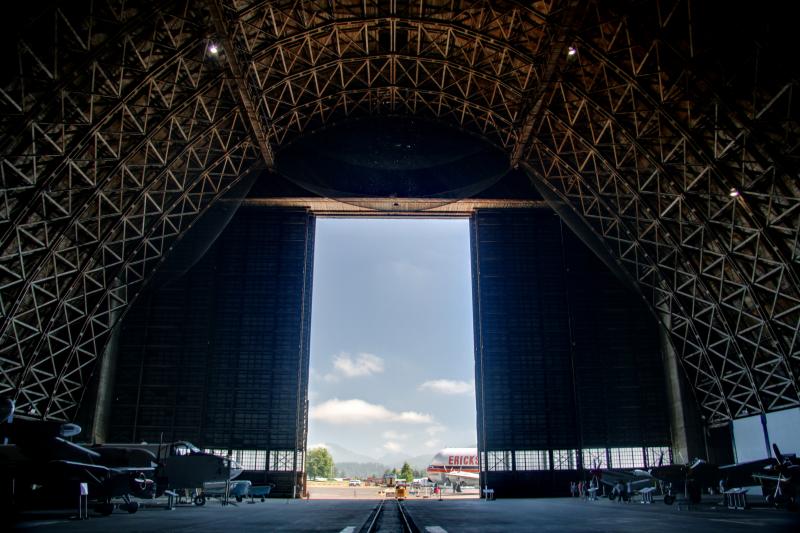
Of course, an extreme case like the Tillamook Air Museum's blimp hanger still needs multiple shots; six in this case, with a 9-stop dynamic range:

IMG_6852_hdr_10_0_0_cf_sml

But now I can reserve the time-consuming sequence shooting for the situations that truly need them.

Wednesday, September 9, 2009

Chasing the Space Shuttle

IMG_3729_sml

At 12:26p Tuesday, the space shuttle Discovery undocked from the International Space Station (ISS). At 9:20p, the pair presented a graceful duet of brighter-than-Venus dots silently gliding overhead. I guess the ISS didn't want the Shuttle to leave, since the space station appeared to be chasing it across the sky. Of course, the ISS will never catch up; the photograph proves it. The eleven-second trace for the Shuttle is 36% longer than the one for the ISS, vividly showing their relative speeds.

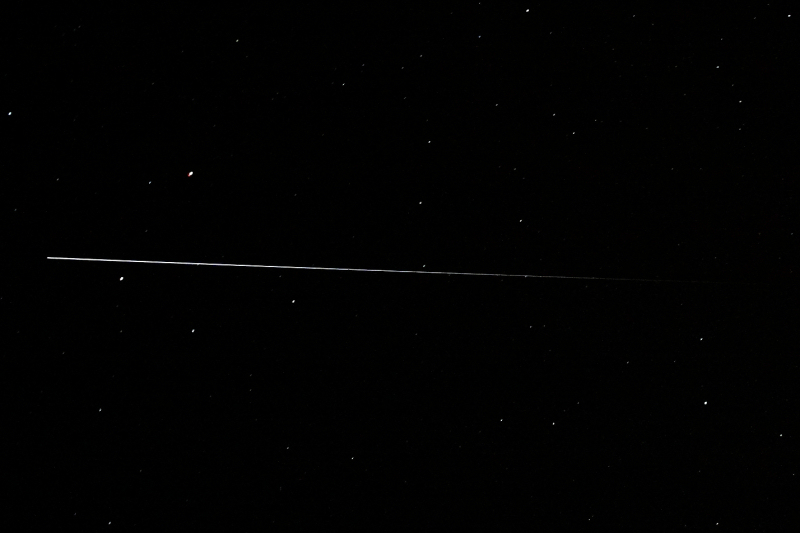
About 30 seconds later, both the ISS and Shuttle disappeared. Here is the trace from the ISS plunge into the darkness of Earth's shadow:

IMG_3731_zoom_sml

To see it larger, click on the image above. To see it full-size, click here.

The last time I saw the ISS and the Shuttle undocked, I was in downtown Cairo, peering between buildings, hoping my view was somewhat toward the southwest. This time was much better! :-)